
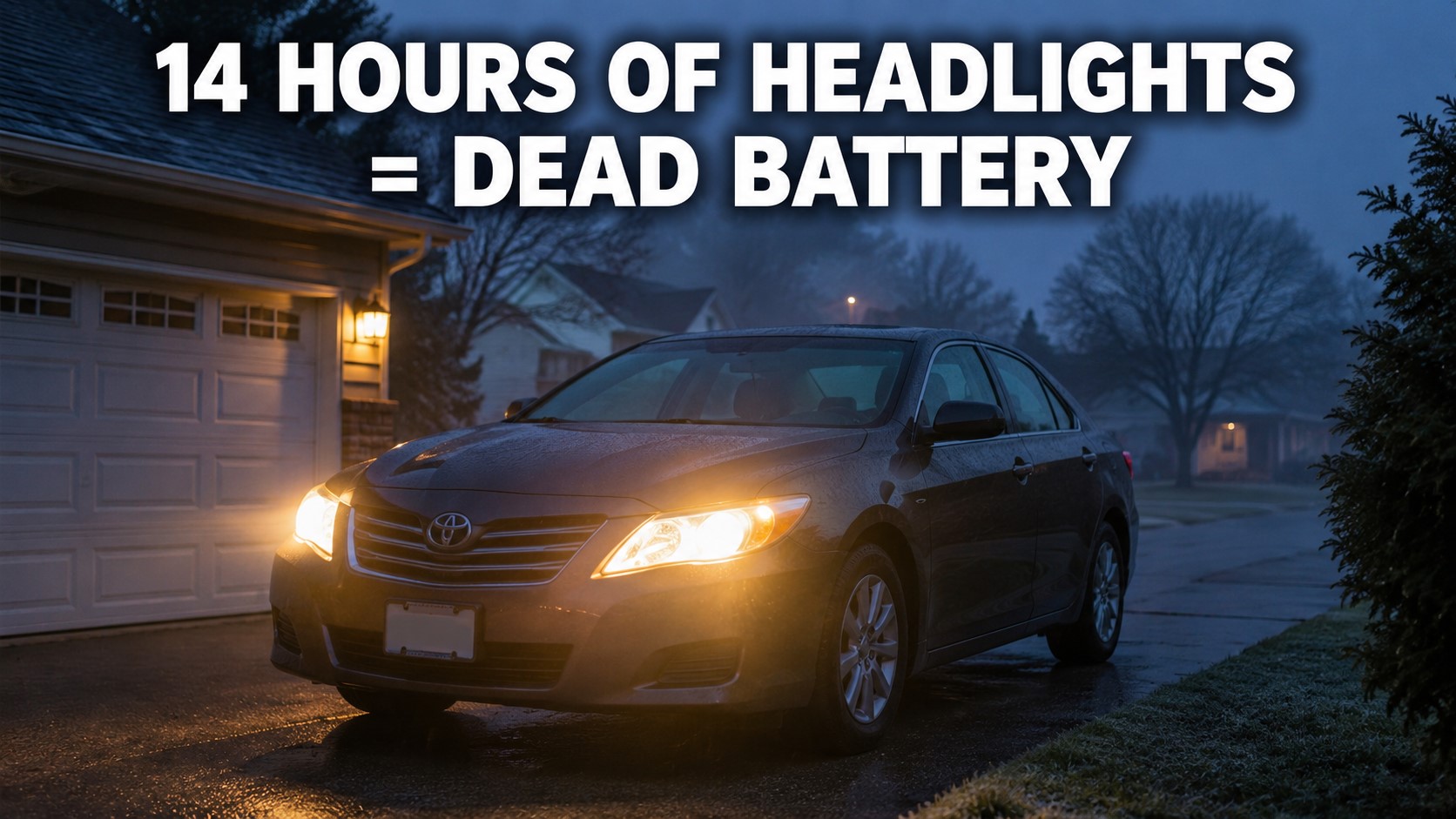
Left car headlights on 14 hours overnight? Find out if your battery is dead or recoverable, how to test it fast, and the exact fix to get moving again.
Leaving car headlights on overnight for 14 hours drains a standard 12-volt battery well past its usable capacity, in most cases pulling the battery down to a state where it can’t crank the engine.
Whether it’s permanently damaged or just deeply discharged depends on your battery’s age and how it’s charged afterward.
You walked out this morning, turned the key, and got nothing. Or maybe just a click. That sinking feeling is normal and it’s fixable more often than you’d think.
Why 14 Hours Is Long Enough to Kill a Battery’s Charge
A pair of halogen low-beam headlights draws somewhere around 9 to 11 amps combined, since each 55-watt bulb pulls roughly 4.5 to 5.5 amps at 12 volts. According to Engineer Fix’s 2025 breakdown of automotive electrical loads✔[1], that continuous draw over 14 hours adds up to well over 100 amp-hours pulled from a battery. Most sedan batteries only hold 45 to 70 usable amp-hours. Do the math, and you’re asking a battery to give up more than it has.
That’s the core issue. It’s not that headlights are some special battery killer it’s just time. A short 20-minute mistake barely dents a healthy battery. Fourteen hours is a different story entirely.
Not every “dead” battery is actually dead. A battery that’s simply discharged will usually accept a charge and bounce back to full health. A battery that’s been pushed into deep discharge for too long especially an older one can suffer permanent sulfation, where lead sulfate crystals harden on the plates and reduce capacity for good. Same symptom this morning. Very different outcome long-term.
Test the Battery Before You Do Anything Else
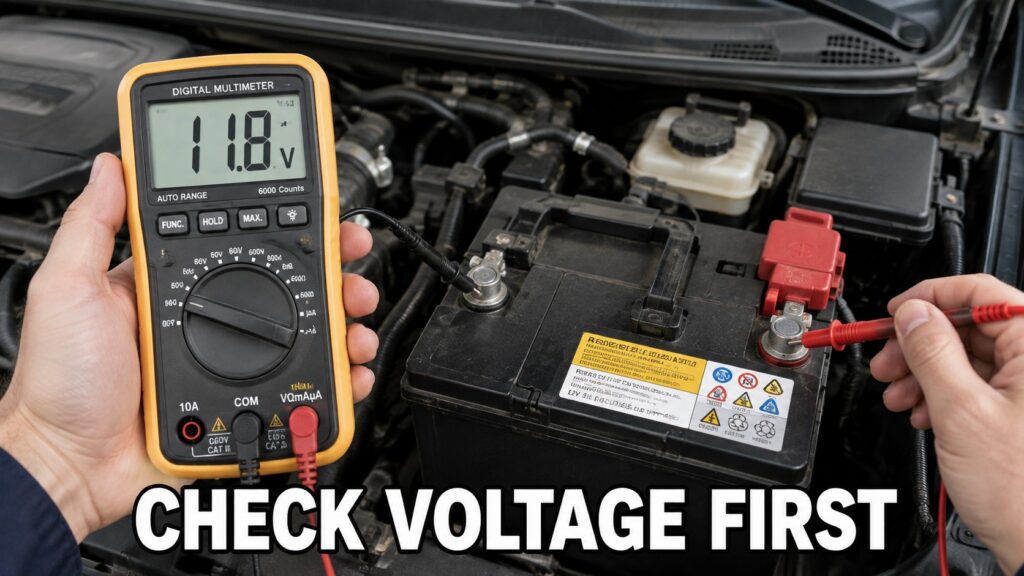
To find out which situation you’re dealing with, follow these steps:
- Turn off all accessories and headlights.
- Set a multimeter to DC volts and touch the leads to the battery terminals.
- Read the resting voltage after a few minutes.
- Will a Drained Battery Cause My Car Not to Start?
A reading above 12.4V means the battery is only lightly discharged and will likely recover with a normal drive or charge. Between 11.9V and 12.4V signals a deep discharge recoverable✔[2], but it needs a proper charger, not just a jump and a drive around the block.
Below 11.9V often means damage has already occurred, and the battery may need replacing regardless of how it charges back up. A cheap multimeter costs about $10 to $15 and takes the guesswork out completely. Worth owning one if you drive an older car.
| Option | Best For | Key Benefit | Limitation |
|---|---|---|---|
| Jump start (NOCO Boost Plus GB40) | Getting the car moving right now | Fast, portable, no second car needed | Doesn't fully recharge the battery — just gets it running |
| Smart charger (CTEK MXS 5.0) | Restoring full battery health overnight | Slowly rebuilds charge without stressing plates | Takes hours, not a same-minute fix |
| Trickle charger (Battery Tender Junior) | Long-term maintenance after recovery | Keeps a marginal battery topped up | Too slow for an urgent morning start |
| Battery replacement (Optima RedTop, Interstate) | Battery reads under 11.9V or is 3+ years old | Guaranteed reliable start | Costs money you didn't plan to spend |
Jump start vs. full recharge: a jump start gets your engine running in minutes but leaves the battery only partially charged, while a smart charger like the CTEK MXS 5.0 restores it properly over several hours. The jump works when you need to leave immediately. The charger works when you actually want the battery healthy again.
Getting the Car Started Safely
If the car won’t crank, resist the urge to keep turning the key. Repeated cranking attempts on a deeply discharged battery force the starter motor to work against insufficient voltage, and that’s a good way to burn out a starter that was otherwise fine. One or two short attempts, then stop and jump-start or charge instead.
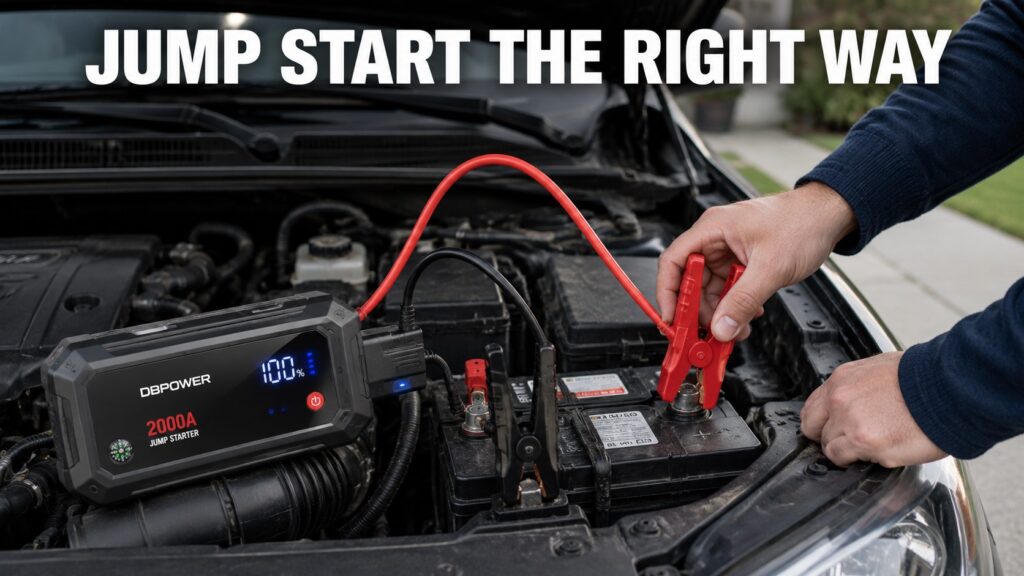
Look if you’re standing in your driveway right now with a dead battery and somewhere to be, here’s what actually works: connect jumper cables or a portable jump starter✔[3], let the donor battery or unit run for a couple of minutes before attempting to start, then drive for at least 20 to 30 minutes afterward so the alternator can begin rebuilding the charge✔[4]. That drive isn’t optional it’s the difference between “fixed” and “dead again tomorrow.”
Some guides suggest just letting the car idle in the driveway after a jump instead of driving it. That works in theory, but idle-charging is far slower than driving and won’t fully restore the battery in the time most people have before work. If you can’t drive, plan on at least an hour of idling minimum and preferably longer.
Will This Happen Again? Preventing the Repeat
Most people assume switching to LED headlights will stop this from happening the truth is a little more complicated. LED bulbs do draw significantly less current, typically 15 to 25 watts versus 55 watts for halogen✔[5], per LED Lighting Info’s 2026 comparison. That’s real, and it does slow the drain. But it doesn’t stop it. Leave LEDs on for 14 hours and you’ll still likely end up with a dead battery, just a somewhat less dead one.
More reliable fix is behavioral, not technical:
- Get into the habit of checking headlights are off before locking the car, especially if your vehicle doesn’t chime a warning.
- Consider an aftermarket auto-off relay if your car lacks automatic headlight shutoff.
- Keep a portable jump starter like the NOCO Boost Plus GB40 in the trunk it’s the cheapest insurance against this exact morning.
This guide covers headlight-related battery drain specifically. It doesn’t cover parasitic drains from faulty alternators, aftermarket electronics, or a battery that’s simply old and failing on its own those need a mechanic’s diagnostic, not a multimeter reading.
FAQs
Will a car battery recharge itself after being drained by headlights?
Not on its own while parked. It needs either driving (alternator charging) or a plug-in charger sitting overnight does nothing.
How long should I drive after a jump start to recharge the battery?
At least 20-30 minutes of steady driving, ideally at higher RPM, not just idling in the driveway.
Should I keep trying to start the car if it won’t crank?
No. Limit attempts to two short tries, then jump-start or charge repeated cranking can damage the starter motor.
What’s the best way to tell if the battery is dead or just discharged?
Test resting voltage with a multimeter. Above 12.4V recovers easily; below 11.9V often means real damage.
When should I just replace the battery instead of recharging it?
If it’s more than three years old, reads under 11.9V after charging, or has been fully drained more than once replacement is usually cheaper than repeat jump starts.
- [1] Engineer Fix — Headlight Amperage Data https://engineerfix.com/how-many-amps-do-headlights-draw/
- [2] AA1Car (ASE-certified mechanic resource) Battery Voltage Testing Reference https://www.aa1car.com/library/2003/us20310.htm
- [3] AAA Club Alliance Jump Starting Safety Guide https://cluballiance.aaa.com/the-extra-mile/advice/car/how-to-use-jumper-cables
- [4] AAA — Post-Jump Recharge Guidance https://shunauto.com/article/how-does-aaa-jump-a-car
- [5] LED Lighting Info Halogen vs. LED Draw Comparison https://ledlightinginfo.com/automotive-lighting/halogen-vs-led-headlights
