
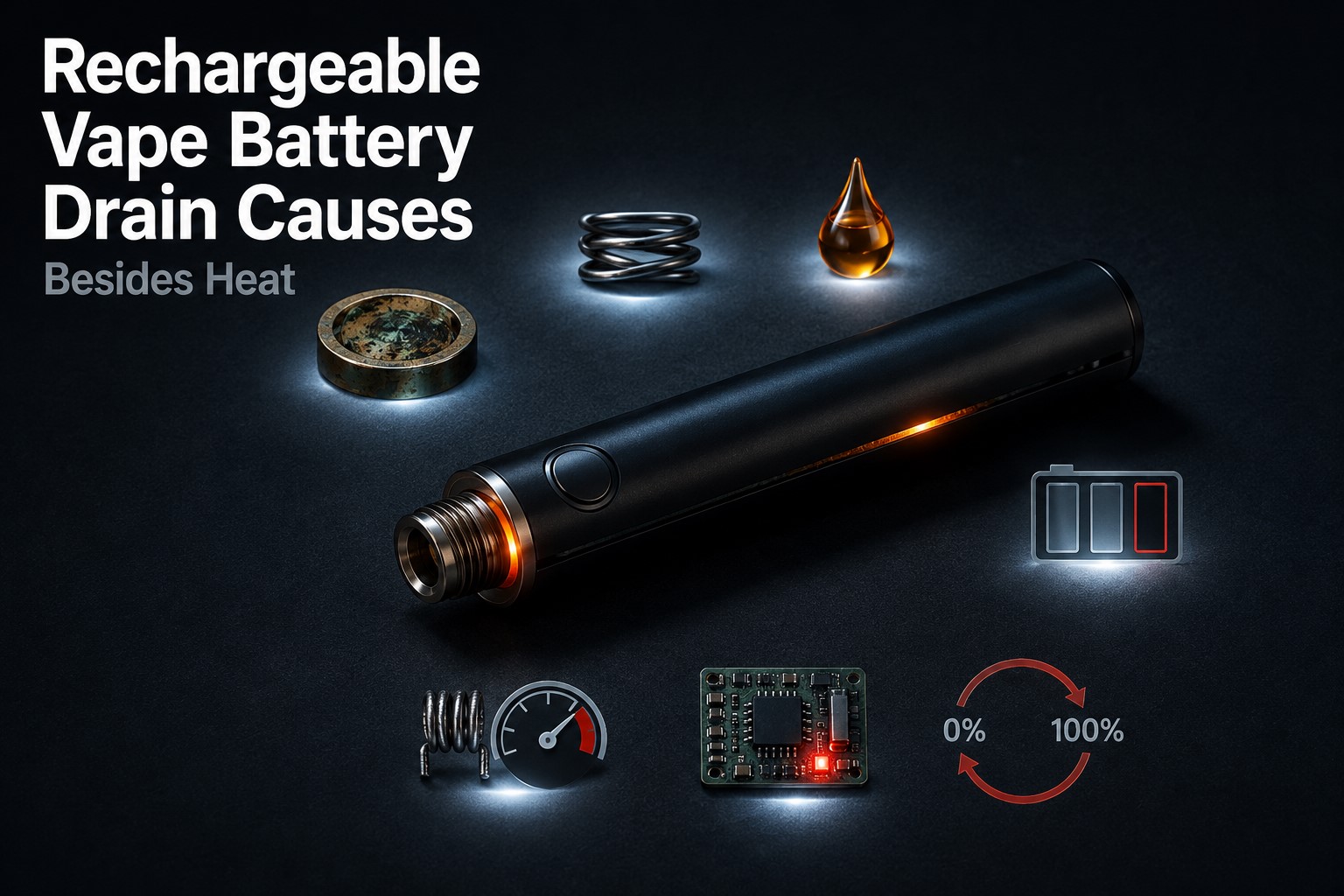
The causes of rechargeable vape battery drain beyond heat and position include, improper charging, device settings, dirty connections, old or damaged batteries, temperature extremes or faulty hardware.
Aside from heat and device positioning, vape battery drain is usually caused by high wattage settings, low-resistance coils, clogged airflow, poor charging habits, or simply aging battery cells.
By addressing these factors, users can significantly extend the battery life and improve the overall performance of their rechargeable vape batteries.
Why Your Rechargeable Vape Battery Keeps Dying and It’s Not Heat
Rechargeable vape battery drain refers to the rate at which a lithium-ion cell loses usable charge between sessions. Causes beyond heat and device position include coil resistance, wattage settings, charge cycle age, parasitic chipset draw, over-discharge habits, dirty contacts, and e-liquid viscosity load.
You’ve already heard the heat lecture. You keep your vape off the dashboard, away from windowsills, never in your back pocket under a hot laptop. You store it upright. You’ve done everything the basic guides say.
Heat and position are the first two causes every vape article covers because they’re easy to explain. The other seven? Those require knowing how lithium-ion cells actually work. That’s what this article is for.
Quick Comparison: Common vs. Overlooked Drain Causes
| Cause | Best For Checking | Key Sign | Fix |
|---|---|---|---|
| High wattage setting | All rechargeable devices | Battery fine in AM, dead by afternoon | Drop wattage 5–10W below coil max |
| Worn coil | Daily vapers, 2+ week coils | Muted flavor, rapid drain | Replace coil |
| Chain vaping | Break-time vapers | Battery crashes mid-shift | 10–15 sec between pulls |
| Cycle degradation | Devices 12+ months old | Gradual worsening over weeks | Replace cell or device |
| Over-discharge habit | Users who drain to 0% | Consistent underperformance | Charge at 20–30% |
| Parasitic chip/screen draw | Regulated mods with display | Overnight drain with no use | Shorten screen timeout, disable BT |
| USB passthrough | Plug-in vapers | Long-term battery shrinkage | Never vape while charging |
Why does my vape battery die so fast even without heat?
A rechargeable vape battery can drain quickly for reasons unrelated to temperature. The most common overlooked causes are wattage set above the coil’s efficient range, a worn coil with uneven resistance, and chain vaping habits that force sustained high-current discharge.
According to lithium-ion battery manufacturers, high discharge rates accelerate capacity loss independently of thermal conditions.
How do charge habits affect vape battery life?
Charge habits directly affect how long a vape battery lasts over its lifetime. Repeatedly draining the battery below 20% accelerates capacity loss in lithium-ion cells, while consistently charging to 100% raises internal stress at full voltage.
According to lithium-ion research compiled by ScienceDirect, managing discharge depth extends total usable cycle count significantly.
Does vaping while charging damage the battery?
Vaping while charging called USB passthrough forces a lithium-ion battery to charge and discharge simultaneously. This elevates internal cell temperature and creates stress that accelerates capacity degradation over time.
While modern devices include protection circuits, regular passthrough vaping measurably shortens battery lifespan compared to keeping charge and discharge cycles separate.
Why Your Vape Battery Dies Fast: 7 Causes That Aren’t Heat or Position
The causes of rechargeable vape battery drain beyond heat and position include:
- Improper Charging: Using incompatible chargers or not charging within the recommended range can reduce battery efficiency.
- Device Settings: High wattage settings and frequent, long drags can drain the battery faster.
- Dirty Connections: Residue from e-liquid or debris on charging ports and contact points can impede power transfer.
- Old or Damaged Batteries: Batteries lose capacity over time and may show signs of damage.
- Temperature Extremes: Storing the vape in very hot or cold places can harm battery cells and reduce performance.
- Faulty Hardware: Defects in the battery or device may cause unexpected power loss.
- USB Passthrough Vaping: Vaping while charging forces the battery to charge and discharge at the same time. This raises internal heat and wears out the lithium-ion cell much faster charge first, then vape.
1. Your Wattage Is Set Higher Than Your Coil Actually Needs
This is the most common hidden cause and the most fixable in under 30 seconds. Every coil has a rated wattage range printed on the side or the box. Most vapers set their device somewhere in that range at setup, then never touch it again. The problem is that max-range wattage isn’t the same as efficient wattage.
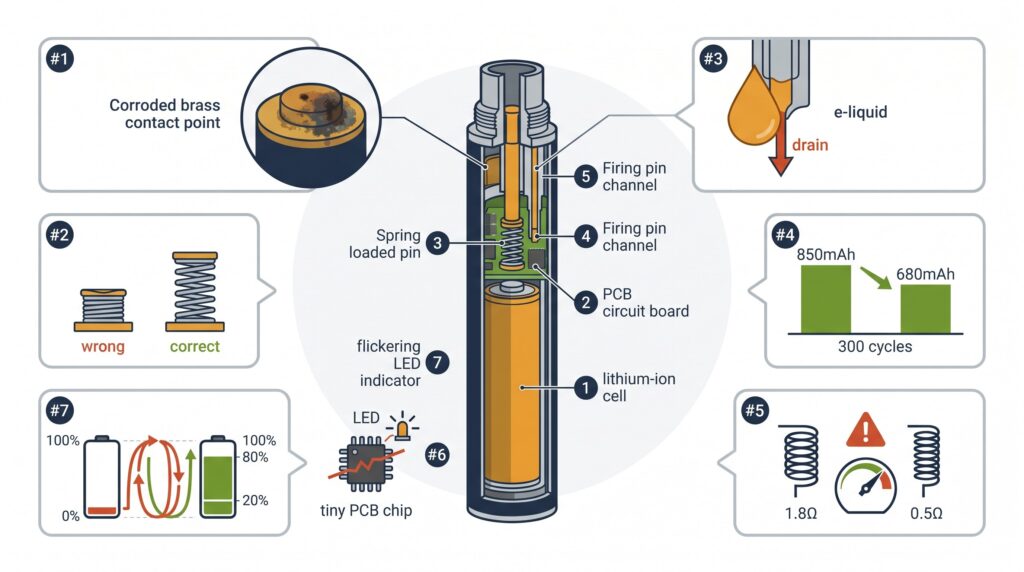
Running a 0.4Ω mesh coil at 45W when 32W produces nearly identical vapor doesn’t just drain your battery faster in the moment — it increases thermal load on the cell itself, which compounds degradation over weeks.
What most guides skip: The relationship between wattage and battery drain isn’t linear. According to power electronics principles, doubling wattage more than doubles the drain rate because of rising internal resistance under high current draw.
Dropping from 45W to 35W doesn’t save 22% of battery — it can save 30–40% depending on your cell’s internal resistance at that charge level.
Drop your wattage 5–10W below your coil’s maximum. You’ll barely notice the vapor difference. Your battery will.
2. Worn-Out Coils Force the Battery to Work Harder
Coils age that’s a fact of vaping life. What people don’t realize is how a dying coil drains battery. As a mesh or kanthal coil oxidizes and its wick degrades, electrical resistance becomes uneven across the heating element.
The device’s chipboard detects inconsistent output and compensates by pulling more current from the battery to hit your set wattage target. You’re not getting better vapor. You’re just burning through more charge to produce the same result.
A coil running 15–20% above its normal resistance profile can reduce effective battery life by a similar margin with no visible sign other than slightly muted flavor and faster drain.
Marcus, a warehouse worker in Columbus, Ohio, ran the same 0.4Ω mesh coil in his SMOK Nord 5 for three weeks past its prime. The staff at Vapor House on N. High Street identified it within two minutes. New coil, dropped wattage by 8W his battery started lasting full 10-hour shifts again within two days.
Quick note: Most coils should be replaced every 1–3 weeks for daily vapers. If your juice is going dark faster than usual and your wattage feels less punchy, that’s the coil, not your battery.
3. Chain Vaping: The Drain Nobody Measures
Taking five rapid pulls back-to-back isn’t just hard on your coil. Each activation draws a burst of current from the battery. Back-to-back draws don’t give the cell’s internal chemistry time to stabilize between discharge events.
A battery delivering one pull per minute can manage its internal temperature and ion flow efficiently. Five pulls in ninety seconds forces the cell into sustained high-output mode which generates internal heat (even when the device stays cool to the touch) and raises discharge depth faster than you’d expect.
I’ve seen conflicting data on exactly how much chain vaping compounds drain versus spaced puffing. Some sources suggest 15–25% faster drain; others put it closer to 10%. My read is that it’s device-dependent high-capacity 18650 mods handle it better than compact pod systems with smaller cells.
Either way, building in 10–15 seconds between pulls reduces the effect measurably.
4. Cycle Degradation: Your Battery Is Just Getting Old
Most 18650 lithium-ion vape batteries are rated for 300–500 charge cycles before significant capacity loss sets in (per Vapebox and standard manufacturer specifications). A daily vaper charging once per day hits that ceiling in roughly 12–18 months — with no heat exposure, no improper positioning, nothing obviously wrong.
The battery doesn’t fail. It just quietly holds less charge than it used to. A cell that once held 3,000mAh at full charge might hold 2,400mAh after 400 cycles. That’s a 20% reduction in run time — invisible to the eye, devastating to your daily use.
Or maybe I should say it this way: if your vape device is more than a year old and you charge it every day, the battery is almost certainly a significant part of your drain problem regardless of what else you’re doing right or wrong.
For devices with removable 18650 cells (like many GeekVape Aegis mods), replacing the cell solves this completely. For built-in battery pods like the Vaporesso XROS line, the device itself may need replacement after 12–18 months of heavy use.
5. The Over-Discharge Trap
Look if you’re someone who vapes your device completely flat before plugging in, here’s what’s actually happening:
Lithium-ion cells suffer irreversible structural damage when discharged below approximately 3.0V. Most modern vape devices cut off before that threshold but repeatedly draining to 5–10% before charging stresses the cell in a way that accumulates over cycles.
According to ScienceDirect’s lithium-ion battery research database✔ (cited in engineering analysis by Vapsolo, 2026), lithium-ion cells degrade significantly faster under deep discharge patterns compounding the natural cycle-count degradation described above.
The fix: recharge when you hit 20–30% remaining. Don’t wait for the low-battery warning.
Counter-intuitive fact most guides miss: Charging your vape to 100% every time also contributes to long-term capacity loss. Lithium-ion cells prefer to live in the 30–80% range. Charging to 80–90% and recharging at 20–30% maximizes total lifespan though charging to 100% occasionally is fine.
6. Parasitic Chipset and Screen Drain (Regulated Mods Only)
Modern regulated box mods devices with color OLED screens, variable wattage menus, Bluetooth pairing, and always-on protection chipboards consume battery even when you’re not vaping.
The chipset monitoring your wattage, the screen lighting up when you press a button, the Bluetooth radio pinging in standby: these draw current continuously.
On a high-end device like the GeekVape Aegis X with an active color display, standby drain can measurably reduce battery life over an 8-hour period especially if the screen timeout is set long or Bluetooth is left active.
What to do: Shorten your screen timeout in device settings. Disable Bluetooth when you’re not using an app. Some devices have a lock mode that reduces parasitic chipset activity use it.
This doesn’t matter much on simple pod systems with no screen. But on any regulated mod with a display, it’s a real factor.
7. USB Passthrough Vaping: The Silent Battery
Using your vape while it’s plugged in and charging feels efficient. You’re not wasting time. You’re not draining the battery.
USB passthrough vaping while charging forces the battery into simultaneous charge and discharge cycles. The lithium-ion cell is absorbing current from the charger while also releasing current to power the coil.
This creates elevated internal temperature even when the device feels fine externally, and it accelerates capacity degradation significantly faster than either activity alone.
Some experts argue passthrough is safe because modern protection chips regulate it. That’s valid for occasional use. But if you’re doing this habitually every day, you’re compressing your battery’s lifespan in ways that compound quickly.
Don’t vape while charging. Charge fully, then vape. It takes the same total time and protects the cell.
8. Dirty or Corroded Battery Contacts
This one is minor but real. The metal contact points between your battery (or pod) and your device’s 510 connector or pod pins accumulate e-liquid residue, oxidation, and pocket lint over time.
Dirty contacts increase electrical resistance at the connection point meaning the device has to draw more current to deliver the same wattage to your coil.
Clean your contacts with a dry cotton swab every week or two. For 18650 batteries with visible corrosion, a very light wipe with isopropyl alcohol on the positive terminal (once fully dry) clears oxidation.
It’s a two-minute fix that’s genuinely underrated.
FAQs: Voice Search
What’s the fastest way to fix a vape battery that drains too quickly?
Replace the coil first worn coils force the battery to draw excess current. Then lower your wattage 5–10W below your coil’s maximum. These two changes fix most fast-drain problems within 48 hours.
How do I know if my vape battery is just old and worn out?
If your device is over 12 months old and you charge daily, the battery has likely completed 300+ cycles. That’s near the rated lifespan for most 18650 lithium-ion cells — reduced capacity is expected and normal at that point.
Should I charge my vape to 100% every time?
Not necessarily. Lithium-ion cells last longest when kept between 30–80% charge. Charging to 80–90% daily and recharging at 20–30% extends total battery lifespan significantly versus charging to full every cycle.
Why does my vape battery drain overnight even when I’m not using it?
Regulated mods with OLED screens and active chipboards draw standby current even when idle. Enabling device lock mode and shortening screen timeout reduces this. Basic pod systems without displays typically don’t have this problem.
When should I replace my vape battery instead of trying to fix drain?
If your device is 12–18 months old, charges fast but dies quickly, and has a built-in (non-removable) battery — replacement is the most practical fix. For devices with removable 18650 cells, replacing just the cell solves it for under $10.
