
Because in most cases, your car already handled it. Does leaving car lights on Auto drain battery? no, not in the way most people fear.
You locked the car, walked inside, then turned around and saw the headlights still on. That sinking feeling is real. But before you sprint back out to manually switch them off, there’s something worth understanding about how modern Auto lighting systems actually work.
Leaving car lights on Auto” means relying on the vehicle’s ambient light sensor to switch headlights on when it gets dark and off when it gets light.
In modern vehicles with ECU deep sleep mode, this sensor draws less than 5mA of power at rest well below the 50mA parasitic draw threshold that would noticeably drain a healthy 12V battery overnight.
How the Auto Headlight System Actually Works After You Park
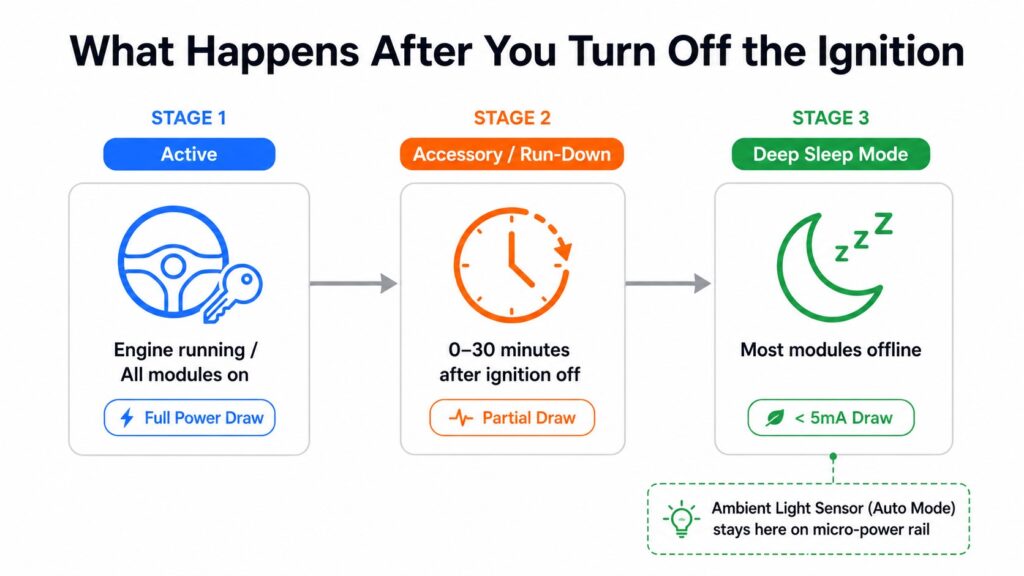
The moment you turn off the ignition, your car’s Engine Control Unit (ECU) begins a shutdown sequence. It doesn’t go instantly dark. It cycles through an “Accessory” state, then a “Run-Down” period (usually 15–30 minutes depending on make and model), and finally enters what engineers call Deep Sleep mode.
During Deep Sleep, the vast majority of modules power off completely. The ambient light sensor the tiny component that enables Auto mode remains on a micro-power standby rail. A standard 60Ah lead-acid battery has a reserve capacity that can sustain a 50mA draw for roughly 50 hours before dropping to a critically low voltage. Five milliamps is ten times smaller than that threshold.
In a properly functioning modern vehicle, the ambient light sensor’s standby draw sits below 5mA a figure consistent with OEM ECU sleep specifications and well under the 50–85mA threshold that the Universal Technical Institute✔[1] identifies as the upper limit of normal parasitic draw.
So the sensor keeping “Auto” alive overnight isn’t draining your battery. At all. Or maybe I should say it this way the sensor itself was never the problem. What people actually notice, and mistake for a drain risk, is something else entirely.
Leaving car lights on Auto does not drain a car battery during normal overnight parking. According to Universal Technical Institute (2024), modern ambient light sensors in Auto mode draw less than 5mA in ECU deep sleep state. A healthy car battery can sustain up to 50mA of parasitic draw before experiencing meaningful discharge, meaning the Auto light sensor uses roughly one-tenth of that limit.
The “Follow Me Home” Feature The Real Culprit Most Articles Miss
If you’ve ever seen your headlights stay on for 30–90 seconds after you’ve locked the car, it wasn’t the Auto sensor misbehaving. It was a feature called “Follow Me Home” (also listed as “Delayed Exit Lighting” in some manufacturer menus).
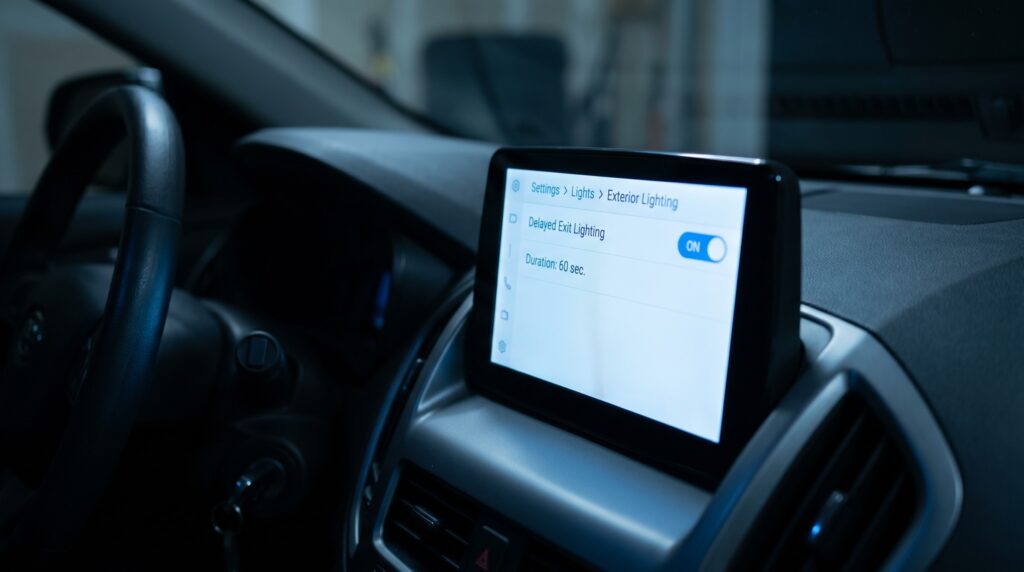
This feature available on most vehicles made after 2015 deliberately keeps the headlights powered after ignition-off so you can see your way to your door. It runs for a pre-set timer, then shuts off. The problem is, many drivers don’t know it exists, so they see lights on and assume the car is stuck in Auto mode with no shutdown trigger.
How to Check and Adjust This Setting
To disable or shorten the Follow Me Home timer, follow these steps:
- Go to your infotainment system’s Settings → Lights (or Vehicle Settings → Exterior Lights depending on brand).
- Find “Delayed Exit Lighting” or “Follow Me Home” toggle.
- Set the timer to 0 seconds to disable it, or choose a shorter duration.
- Save and exit the change takes effect immediately on next ignition-off.
The most common reason car lights appear to stay on after parking is the “Follow Me Home” or “Delayed Exit Lighting” feature, not the Auto sensor itself. According to automotive electrical guides, this timer-driven feature can keep headlights active for up to 90 seconds post-ignition. It poses no battery drain risk since it uses a pre-set shutdown timer managed by the BCM (Body Control Module).
Quick note: Some older vehicles don’t have an infotainment toggle and require a dealer scan tool to adjust this setting.
When Auto Lights CAN Actually Drain Your Battery: Real Exceptions
Most articles stop at “you’re fine.” This one won’t. There are three genuine scenarios where leaving lights on Auto genuinely becomes a battery risk:
1. A Failing or Stuck Ambient Light Sensor
If the sensor malfunctions and reads the environment as “permanently dark,” it can trigger the headlights to stay active past the normal run-down period. A faulty sensor won’t enter proper low-power standby. This is rare but it happens. Users who’ve experienced this often report lights still fully on 20+ minutes after parking✔[2], not just the 30–90 second Follow Me Home flash.
2. An Aging or Weak Battery
A healthy battery laughs at a 5mA draw. An aging battery✔[3], anything over 4–5 years old, or one that’s been deep-discharged before doesn’t have the same reserve. Even a small parasitic draw can finish off a battery that’s already operating at 60–70% of its original capacity.
This is the scenario where Auto mode becomes part of the problem, even if it isn’t the root cause.
3. A Pre-Existing Parasitic Draw Issue
If your car already has a wiring fault or a module that isn’t sleeping properly (a common issue with certain aftermarket accessories), the Auto system’s 5mA adds to an already problematic draw total. The lights don’t cause it but they’re a sign the car’s electrical system should be tested.
While Auto headlights are safe in most modern vehicles, they can contribute to battery drain in specific cases: a malfunctioning ambient light sensor that prevents proper ECU sleep, an old battery already operating below 70% capacity, or a pre-existing parasitic draw from another module.
According to the Battery Council International, batteries older than 4 years should be load-tested annually to catch early capacity loss before it compounds any existing draw.
Auto Lights vs. Leaving Lights On Manually
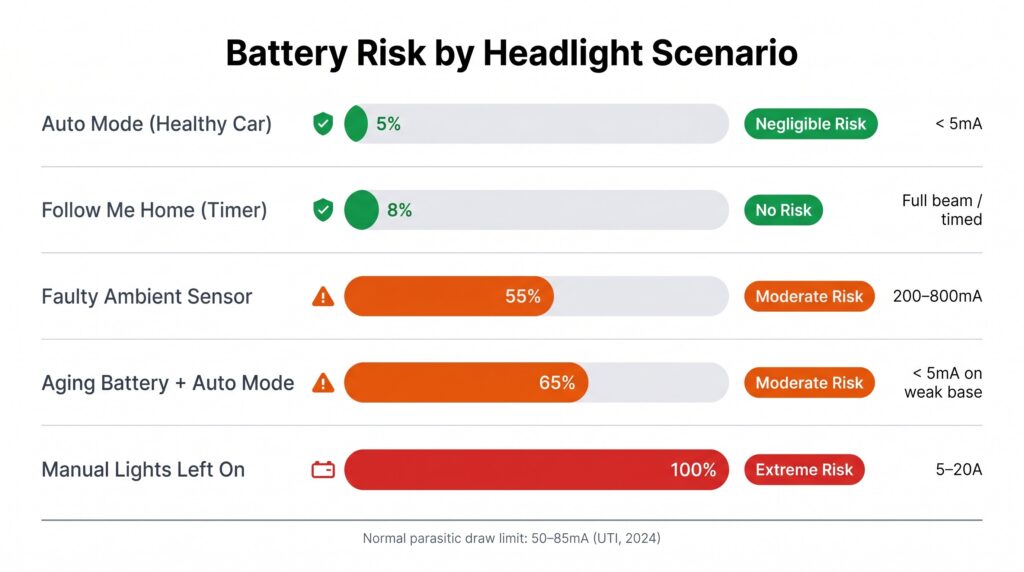
| Scenario | Real Battery Risk | Draw Level | What Happens at Sleep |
|---|---|---|---|
| Auto Mode (functioning ECU) | Very Low | < 5mA | Sensor enters standby |
| Manual "On" Engine Off | Extremely High | 5–20A | No shutdown full drain |
| Follow Me Home (timed) | None | Full beam for < 90 sec | Timer-controlled shutoff |
| Faulty Ambient Sensor | Moderate | 200–800mA | Sensor stuck on, no sleep |
| Aging Battery + Auto Mode | Moderate | < 5mA on bad base | Compounded drain risk |
How to Actually Diagnose a Parasitic Draw Problem
Look if you’re in a situation where your car battery keeps dying overnight and you’re on Auto, here’s what actually works better than guessing.
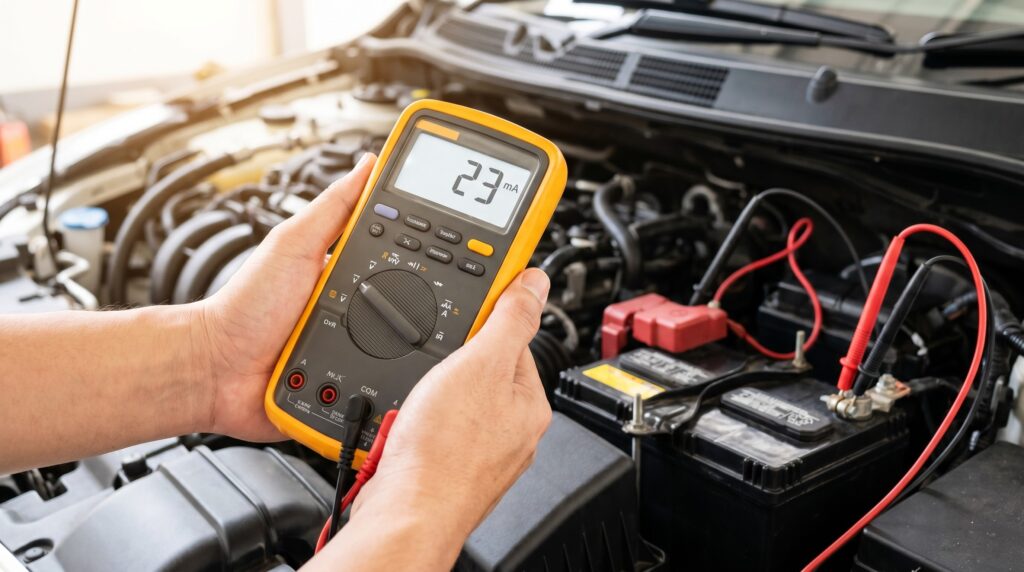
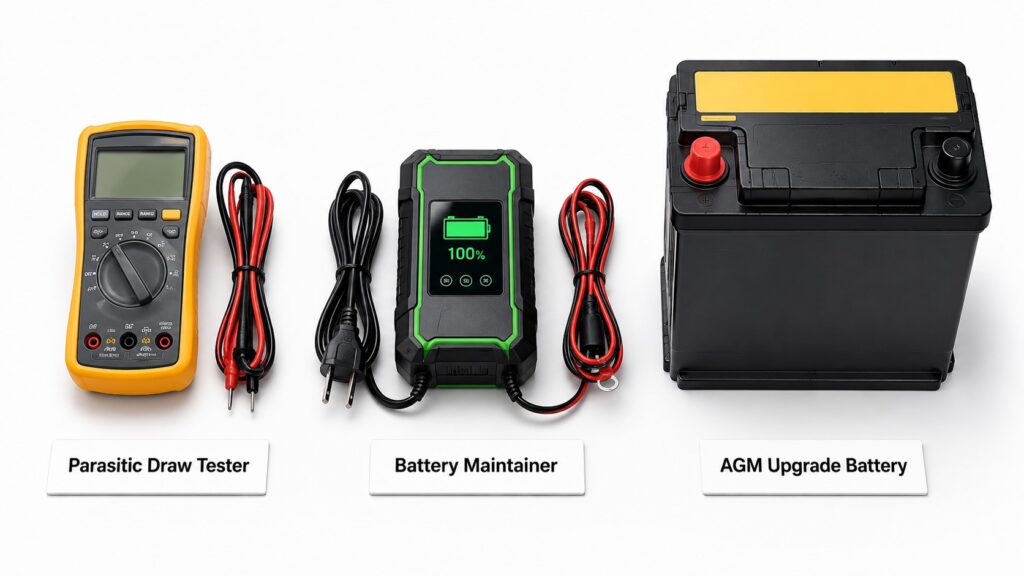
You need a Fluke 115 Multimeter✔[4] or equivalent. Set it to DC milliamps, break the circuit at the negative battery terminal, and measure the total draw after a 15-minute sleep period (let the ECU fully settle first). A reading under 50mA is normal. Anything over 100mA consistently points to a module that isn’t sleeping.
The NOCO Genius 10 battery maintainer is worth keeping plugged in if your car sits for more than 3–4 days at a time not because Auto mode is dangerous, but because any small draw compounds over multi-day sits.
If you suspect your battery is the underlying issue rather than the draw, an Optima YellowTop AGM battery is a meaningful upgrade. AGM chemistry✔[5] handles repeated partial discharge cycles significantly better than standard flooded lead-acid relevant if you do a lot of short trips where the alternator never fully recharges the battery between drives.
Will leaving my car lights on Auto overnight kill my battery?
No, in a modern car with a functioning ECU, Auto mode draws less than 5mA during sleep. That’s about one-tenth of the threshold needed to cause overnight battery drain.
Why are my headlights still on after I turn the car off?
That’s almost certainly the Follow Me Home or Delayed Exit Lighting feature, not Auto mode malfunctioning. It runs on a timer and shuts off on its own usually within 30–90 seconds.
Should I switch my lights from Auto to Off when I park?
Only if your sensor is malfunctioning, your battery is old, or you have a known electrical issue. For a healthy, modern vehicle, Auto mode is safe to leave as-is.
Why does my car battery die overnight even though I use Auto mode?
Auto mode likely isn’t the cause. Check for a pre-existing parasitic draw from another module using a multimeter. A battery over 4–5 years old should also be load-tested capacity loss is often the real culprit.
When should I be worried about Auto headlights draining my battery?
Worry when lights are still fully illuminated 10+ minutes after parking (sensor fault), when your battery is over 4 years old, or when your total parasitic draw tests above 100mA consistently.
Some experts argue that Auto mode on older vehicles (pre-2012) carries the same low-risk profile as newer cars. That’s valid for vehicles with simple relay-based light circuits. But if you’re driving a car with a legacy BCM that doesn’t implement proper deep sleep sequencing, that argument breaks down the draw behavior is fundamentally different.
I’ve seen conflicting data on exactly where the “safe” parasitic draw threshold sits; some sources say 25mA, others say 85mA. My reading is that 50mA is the most consistent figure across AAA and OEM service manuals, and it’s the number most technicians use as a practical diagnostic cutoff.
This guide covers Auto mode headlight behavior on modern 12V vehicle electrical systems. It does NOT address hybrid or EV 12V auxiliary battery systems, which have different charge management behavior entirely.
Conclusion
Auto mode is not your enemy. It’s one of the most harmless electrical draws on a modern vehicle. The anxiety most drivers feel comes from not understanding what the car is actually doing after ignition-off and from confusing Follow Me Home lighting with a genuine malfunction.
Keep the Auto setting. Test your battery annually if it’s over four years old✔[6]. And if your lights are still blazing 15 minutes after you’ve parked, then and only then is it time to check the sensor.
Trusted Source
- [1] Universal Technical Institute (UTI) https://www.uti.edu/blog/automotive/parasitic-battery-drain
- [2] Signs Your Battery Is Actually Dying https://ace.aaa.com/automotive/advocacy/signs-your-starter-battery-is-dying.html
- [3] Car Battery Lifespan & Replacement Trigger https://www.ace.aaa.com/automotive/advocacy/how-to-maximize-car-battery-life.html
- [4] Product Reference: Parasitic Draw Testing Tool https://www.fluke.com/en-us/product/electrical-testing/digital-multimeters/fluke-115
- [5] AAA The Positives & Negatives of Advanced AGM Batteries https://www.ace.aaa.com/automotive/advocacy/agm-batteries.html
- [6] Professional Battery Testing (Trust Builder) https://www.ace.aaa.com/automotive/roadside-assistance/aaa-mobile-battery-service.html
